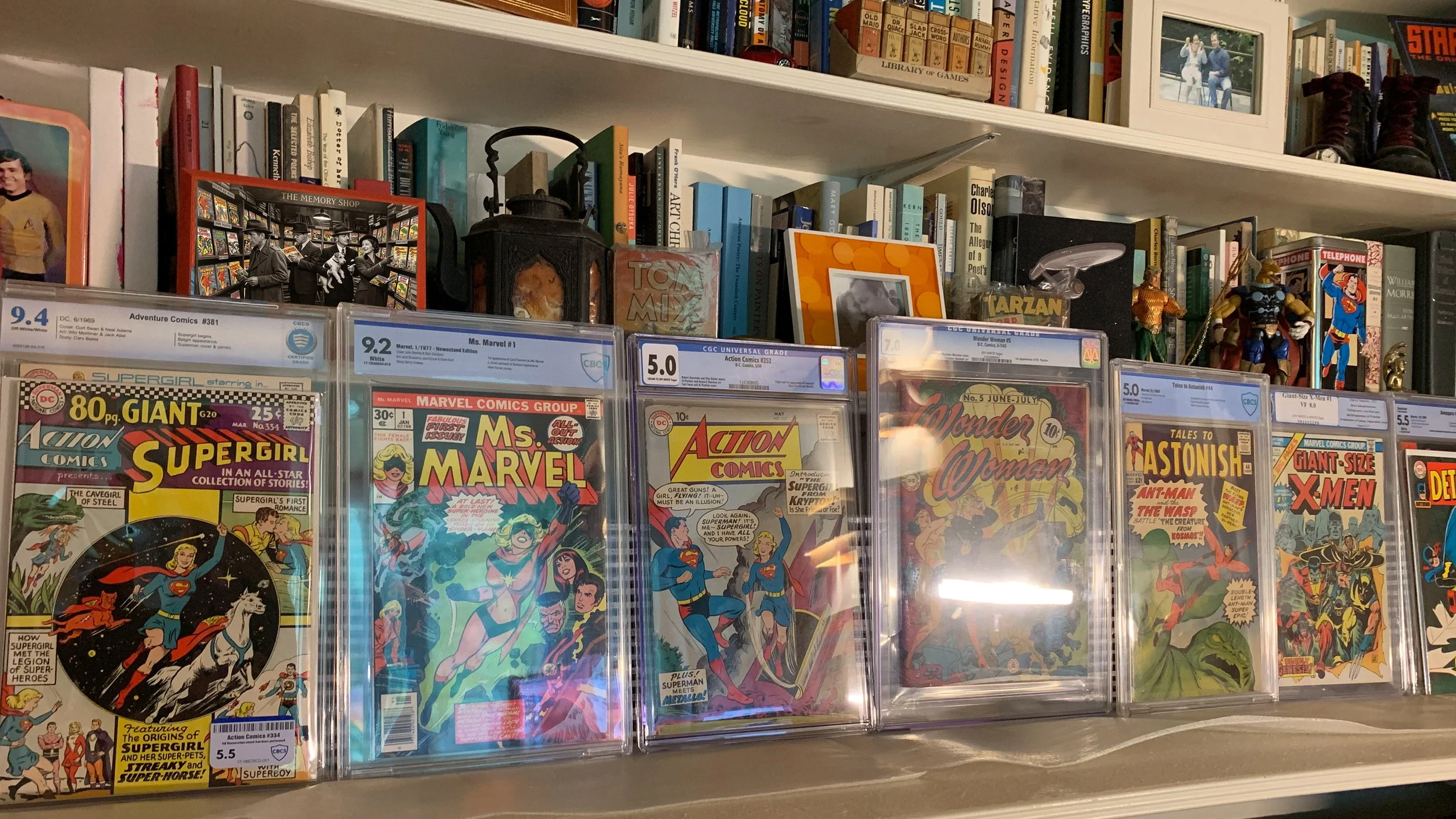
Memorable Times. Memorable Objects.
Rare comics and cultural artifacts. Chosen with care. Sold with conviction.
Featured ComiCS
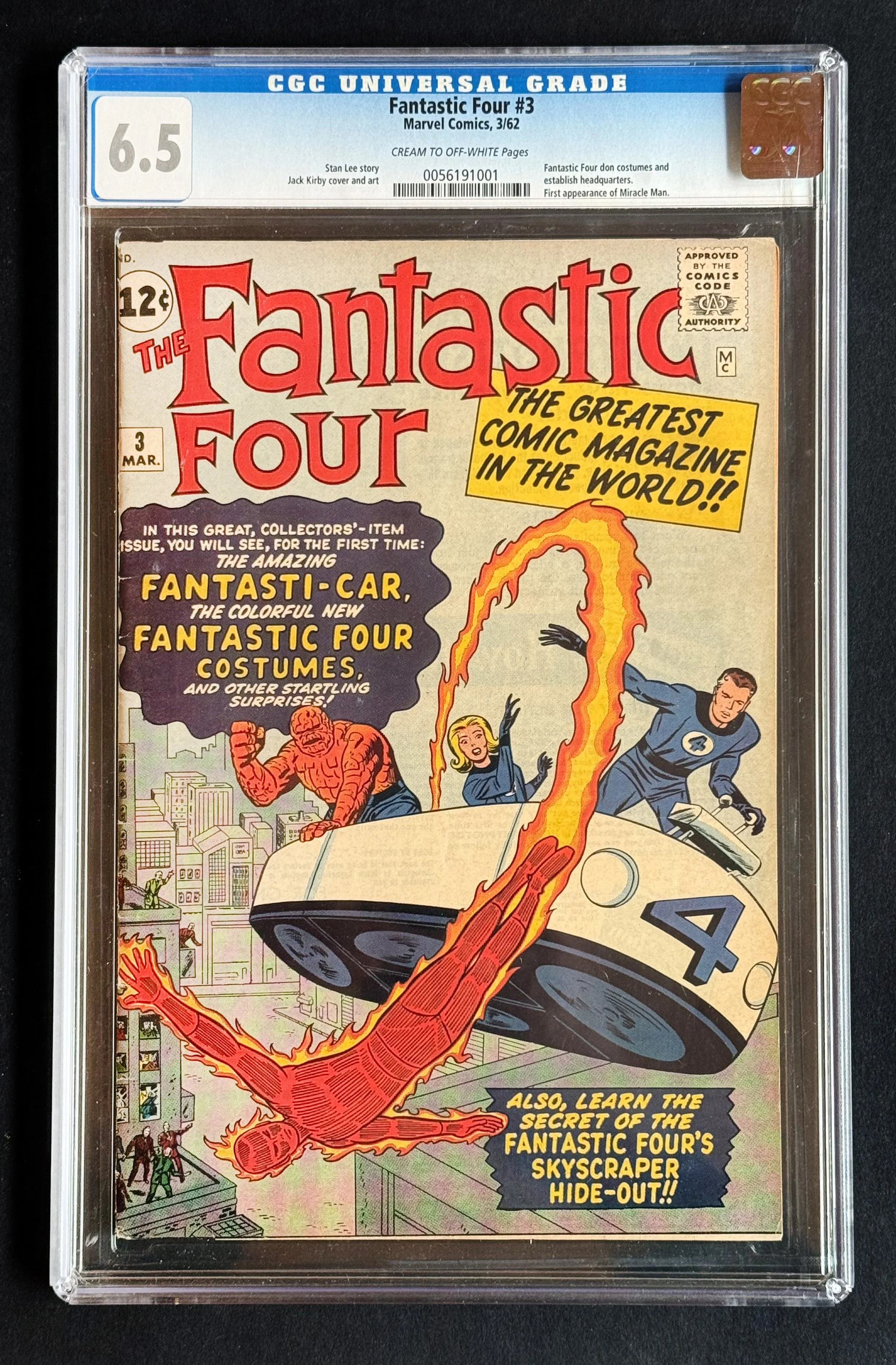
The first two issues introduced them. This is the one where they became themselves. Issue three is when the Fantastic Four put on their costumes, moved into the Baxter Building, unveiled the Fantasti-Car, and declared to the world — and to readers — that something genuinely new had arrived in comics.
Currently #31 on Overstreet’s Top 50 Silver Age Comics list, FF #3 is a foundational key that tends to get overlooked in the shadow of issue one. It shouldn’t be. This is the issue that established the visual and structural identity of the team that Stan Lee and Jack Kirby would build a universe around.
Certified by CGC at 6.5 Fine+ — a clean, presentable mid-grade copy of a 1962 book. With Avengers: Doomsday arriving in December 2026 and the FF at the center of it, the timing for a book like this is only going one direction.
DETAILS
Issue Fantastic Four #3 · Marvel Comics · March 1962
Key 1st appearance of the Fantastic Four in costume
Also features 1st appearance of the Fantasti-Car MK I and the Baxter Building
Also features 1st appearance of Miracle Man
Credits Cover and art: Jack Kirby · Story: Stan Lee
Grade. CGC 6.5 Fine+
Ranking #31 on Overstreet’s Top 50 Silver Age Comics
Marvel’s Space-Born Super-Hero.
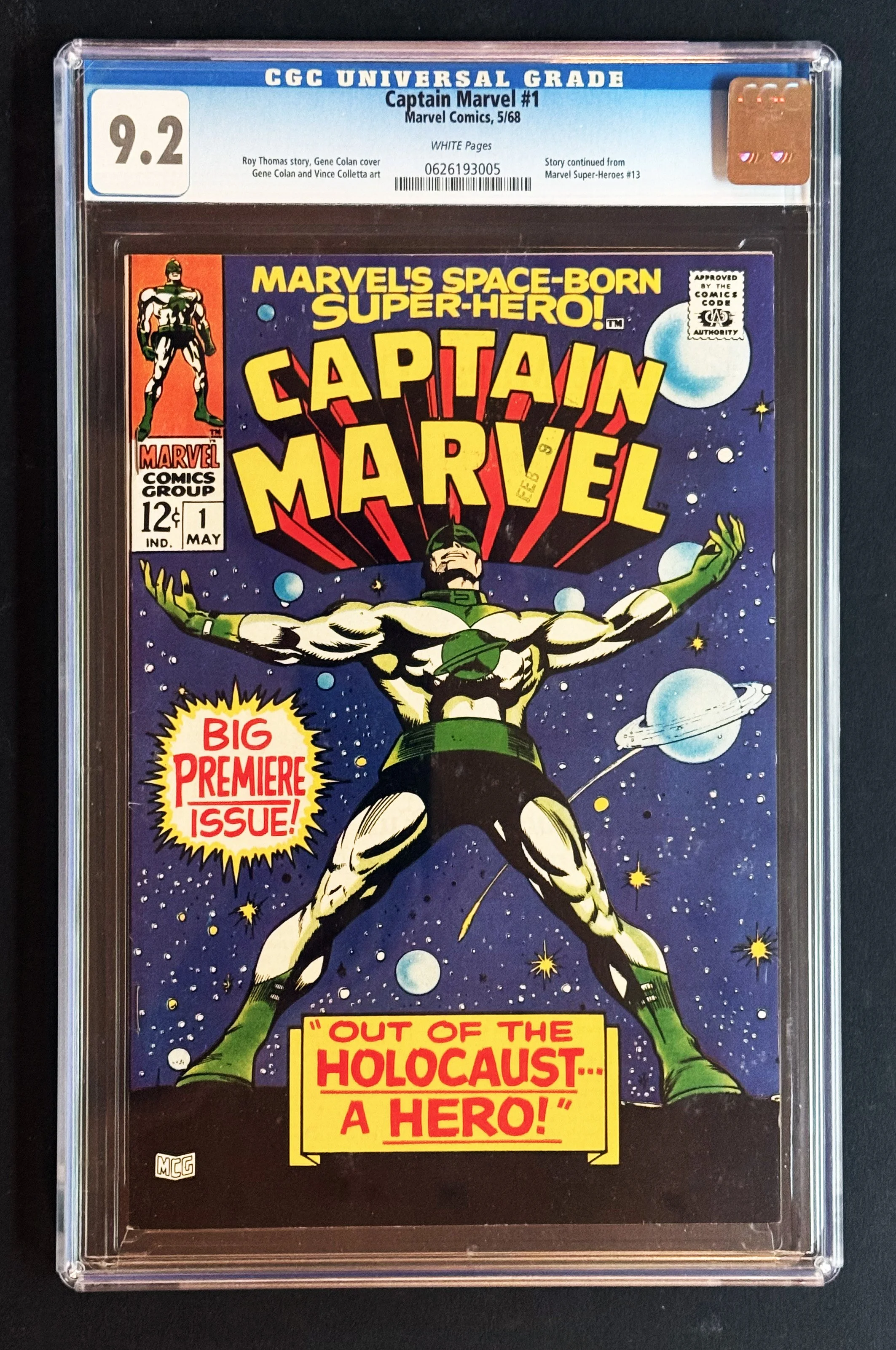
By the spring of 1968, Marvel had a problem worth having: too many heroes and not enough titles. Mar-Vell, the Kree warrior who first appeared in Marvel Super-Heroes #12, had earned his own book — and Captain Marvel #1 is where the cosmic corner of the Marvel Universe began to take its modern shape.
Gene Colan drew him lean and strange, more astronaut than strongman, floating in a green-and-white suit against Colletta’s inky starfields. Roy Thomas wrote him as a soldier caught between duty and conscience — an alien learning, reluctantly, to care about the planet he was sent to surveil. It’s a first issue that reads like a threshold, and everything from the Kree-Skrull War to the character’s later cosmic reinventions traces back through this book.
This copy is graded CGC 9.2 with White Pages — a genuinely high grade for a newsstand book approaching sixty years old. The cover shows the crisp register and saturated color the grade implies, and retains its original period date stamp: a small, honest mark of where and when it once sat on a rack. Housed in an older CGC holder.
CGC 9.2 · White Pages · Marvel Comics, May 1968.
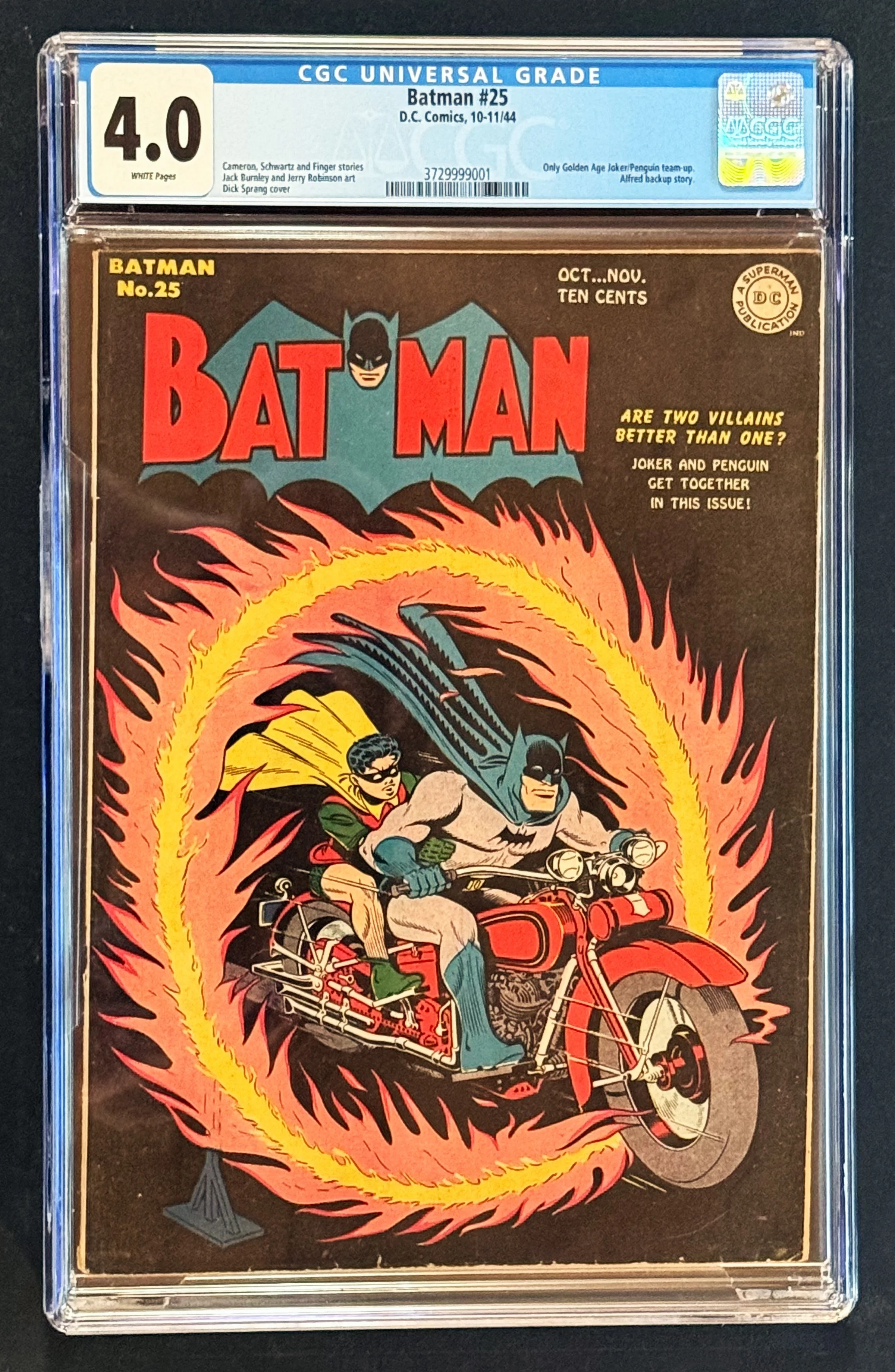
Eighty years ago, DC Comics asked a question on the cover of this issue: are two villains better than one? The answer, as any Batman reader could tell you, is emphatically yes.
Batman #25 contains the only Golden Age team-up of the Joker and the Penguin — the two most iconic villains in Batman’s rogues’ gallery, together for the first and only time in the Golden Age of comics. Jack Burnley and Jerry Robinson handled the interior art, and Dick Sprang — one of the defining Batman artists of the era — delivered the cover. The result is a book that reads as a historical artifact and a genuinely great piece of Golden Age storytelling.
White pages in a 1944 book are exceptional. This CGC 4.0 is a sturdy, well-preserved Very Good copy — honest grade for a book that is over eighty years old and surviving remarkably well. An essential piece for any serious Golden Age or Batman collection.
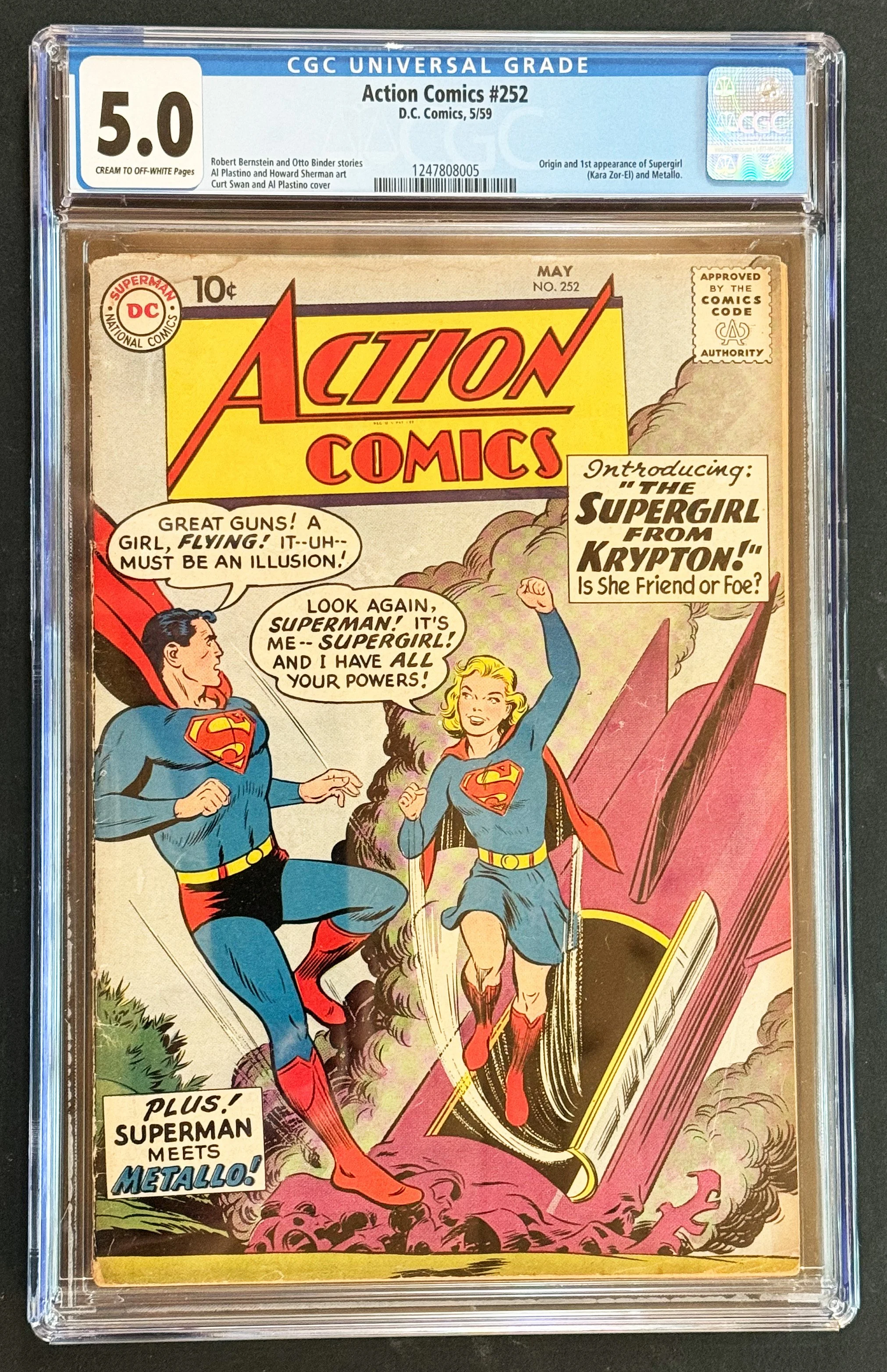
In the summer of 1959, Otto Binder and Al Plastino did something the editors of Action Comics had quietly been building toward for years: they gave Superman a family. Action Comics #252 introduces Kara Zor-El — Supergirl — in a story that hits every note a first appearance should: origin, pathos, wonder, and a dramatic full-cover reveal that left readers no doubt a new character had arrived to stay.
The story is deceptively compact. In seven pages, Binder establishes Argo City's miraculous post-Krypton survival, Zor-El's desperate gamble to save his daughter, and Kara's arrival on Earth with powers equal to her famous cousin's. Plastino's art is warm and accessible in the way only late-'50s DC could manage — clean, bright, enormously readable. The cover, penciled by Curt Swan with inks by Al Plastino, frames the meeting of the two cousins against Kara's crashed rocket with a dramatic simplicity that became one of the era's most reproduced images.
Sixty-seven years later, with Supergirl: Woman of Tomorrow arriving on June 26, 2026, this is the book everyone is looking for. Action Comics #252 is currently ranked #16 on Overstreet's Top 50 Silver Age Comics, and surviving mid-grade copies are genuinely scarce — this was a heavily circulated newsstand title in an era before protective bags and boards were standard practice.
This copy grades CGC 5.0 (Very Good/Fine) with Cream to Off-White pages. It presents solidly for the grade — a real, holdable, readable piece of Silver Age history with a third-party grade to anchor the transaction.
Featured BOOKS
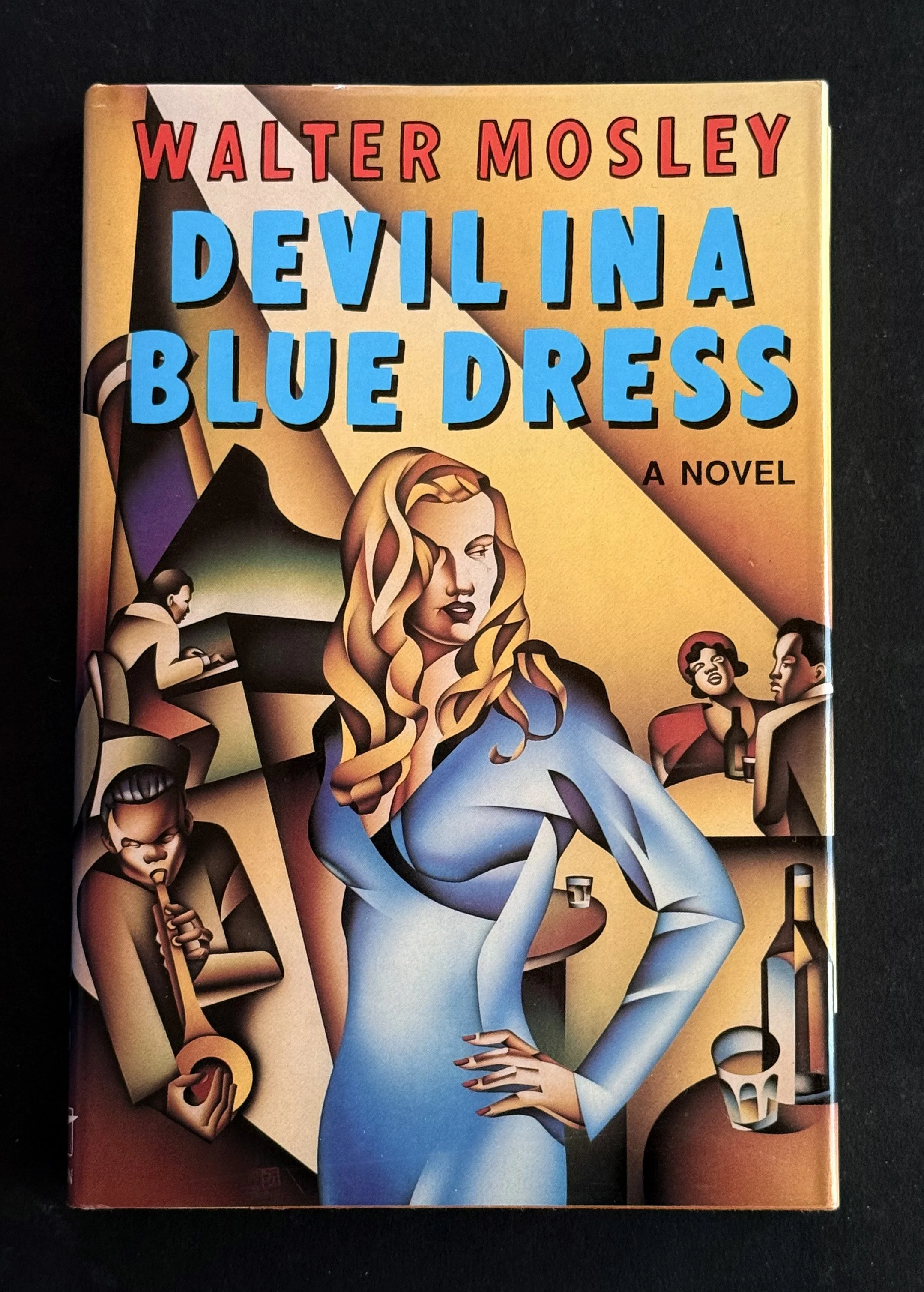
Some debuts announce a career; this one announced a movement. When W. W. Norton published Walter Mosley’s first novel in 1990, the American crime tradition had been waiting decades for the book without knowing it. Easy Rawlins — Black, broke, recently fired, in possession of a small house he cannot afford to lose — walks into a job offered by a man named DeWitt Albright, and walks the reader into a Los Angeles that the genre’s white masters had been writing around for half a century.
The Norton first edition is the artifact of that arrival. The jacket photography, the typesetting, the period-appropriate trim — all of it speaks to the moment Mosley landed: a literary debut from a press not normally associated with genre fiction, presented seriously, given its full weight. This copy retains the dust jacket in near-fine condition with the original $18.95 price unclipped. For collectors of postwar African American literature, of the modern detective novel, or of significant American debuts, the 1990 Norton first is the place to begin.
Condition: Fine in near-fine dust jacket. Boards tight and square, no shelf wear. Dust jacket clean and unclipped — original $18.95 price retained. Interior clean and unmarked; no inscriptions or bookplates. Stated First Edition with full number line to 1. ISBN 0-393-02854-2.
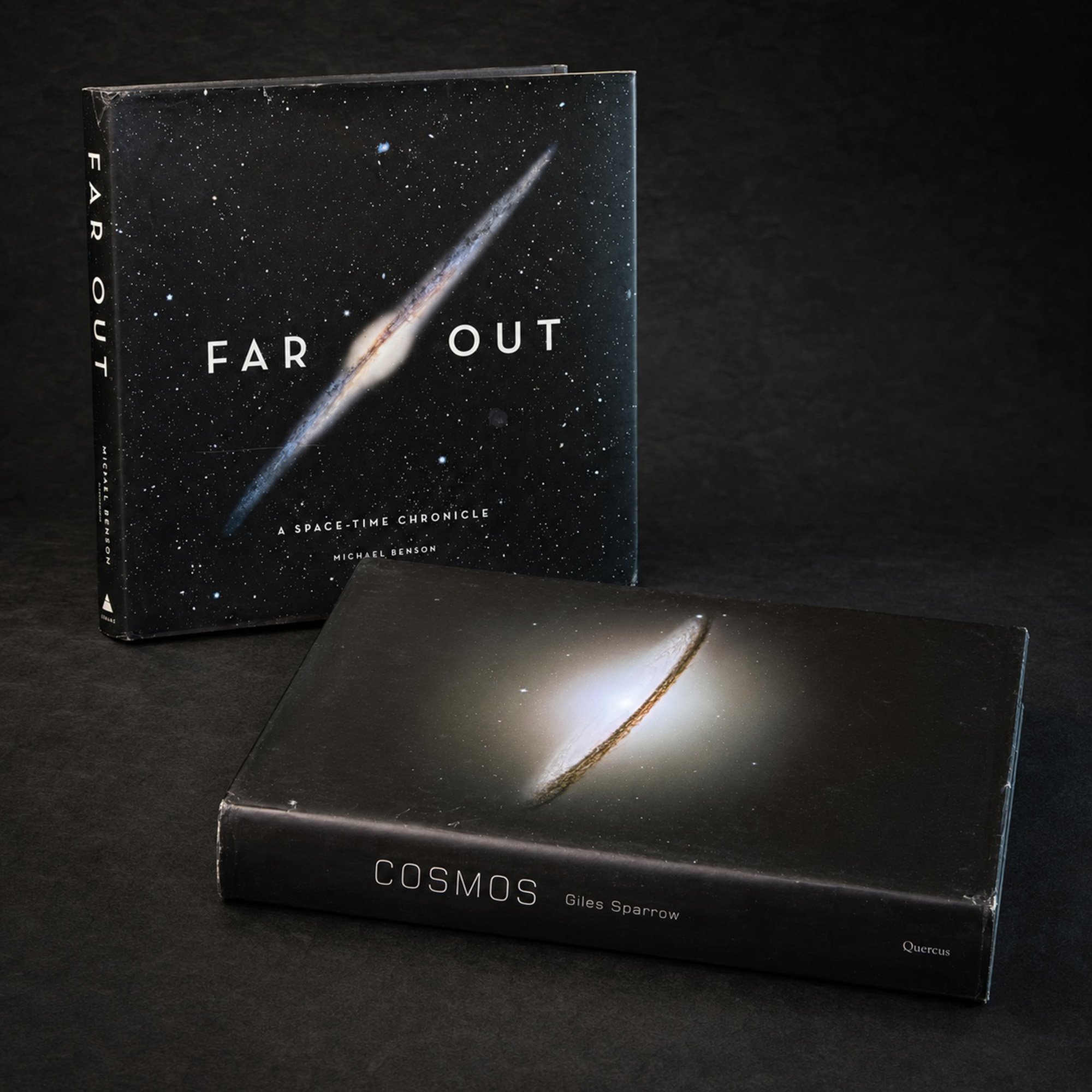
Some books are meant to be read. These two are meant to be opened flat on a table and gotten lost in.
Far Out: A Space-Time Chronicle and Cosmos: A Field Guide both belong to a small shelf of astrophotography books that earned real critical attention outside the astronomy world — praised in the same breath as 2001: A Space Odyssey by the film’s own visual effects supervisor. Together they cover the same territory from two different angles: Far Out as a chronological journey through space-time, Cosmos as a structured field guide from Earth’s orbit to the edge of the observable universe.
Both are oversized hardcovers with dust jackets, showing honest wear from a life on the shelf — light scuffing, scratches, minor tears, a bumped corner — but the photography inside, hundreds of images between the two volumes, is undiminished.
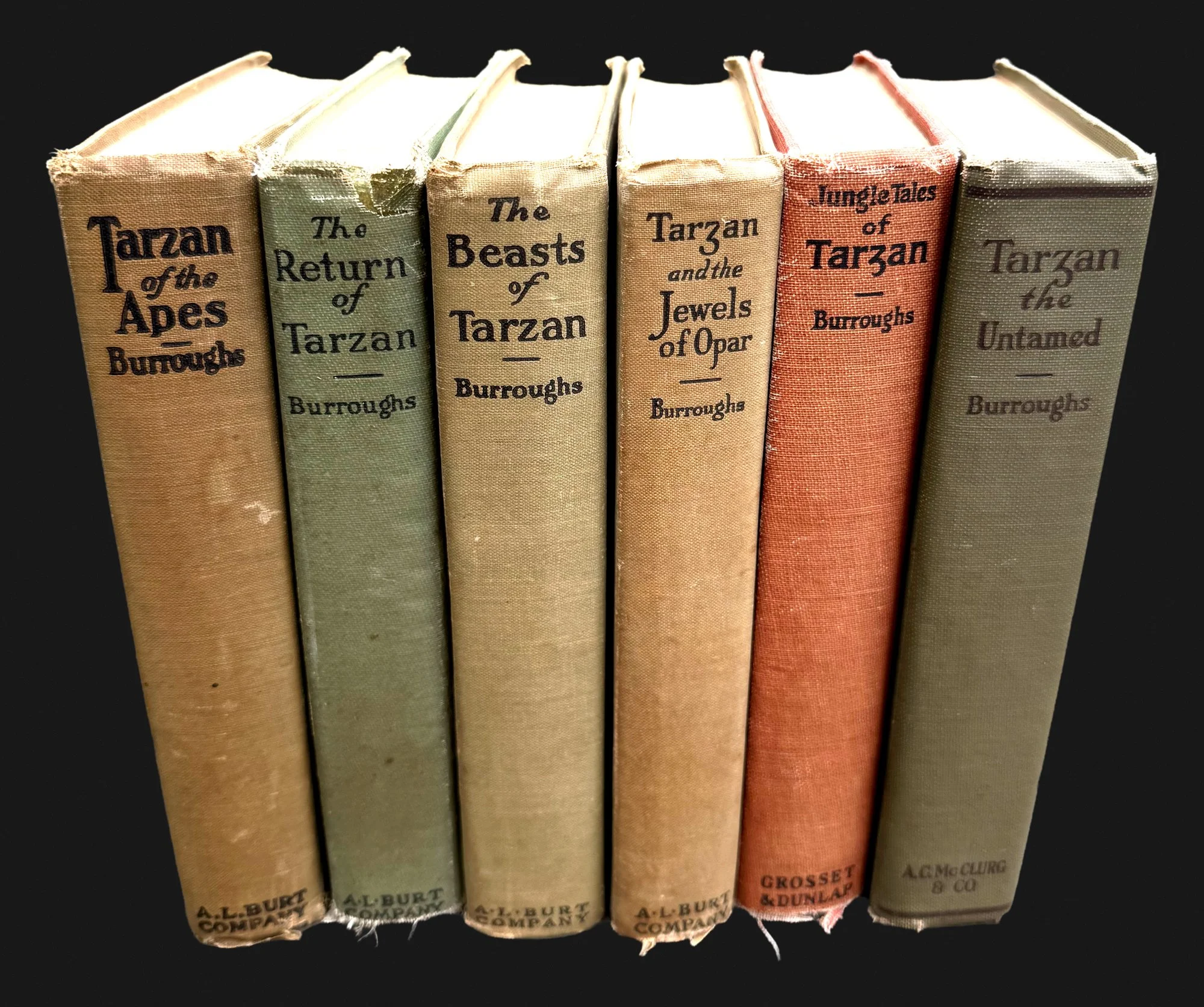
Edgar Rice Burroughs, including the 1920 McClurg first printing of Tarzan the Untamed
Collectors chase the McClurg firsts. But the McClurg firsts aren't how Tarzan got into America's hands. That job fell to A. L. Burt and Grosset & Dunlap, the reprint houses that took McClurg's plates, printed them on thinner paper in cheaper cloth, and sold them for a fraction of the price. A McClurg first went onto a collector's shelf. A Burt went into a boy's bedroom and got read until the headcap frayed.
This group has both. Five early reprints cover the ape-man's origin, his return, the beasts, the jewels of Opar and the jungle tales of his boyhood. At the end of the row is the real thing: Tarzan the Untamed, McClurg, Chicago, April 1920, first printing. Tarzan takes on the German army in East Africa, and then the book swerves into Xuja, a lost city of lunatics. The plates are by J. Allen St. John, the artist who decided what Tarzan looked like. Every illustrator since, Frazetta included, has had to answer him.
Someone numbered these as they bought them: I, II, III, V, VI, VII. Number IV, The Son of Tarzan, never arrived. The Opar title page lists it among Burroughs's other books, which must have stung.
They're used and honestly worn: frayed spine ends, rubbed cloth, no jackets, old dried staining on the back of Jewels of Opar. The Untamed is missing one of its nine plates, with no sign it was ever bound in. Not a fine set but a well-read one, and that's the point.
The set: Tarzan of the Apes, The Return of Tarzan, The Beasts of Tarzan, Tarzan and the Jewels of Opar (A. L. Burt reprints); Jungle Tales of Tarzan (Grosset & Dunlap reprint); Tarzan the Untamed (A. C. McClurg, 1920, first edition, first printing).
Featured ARTIFACTS
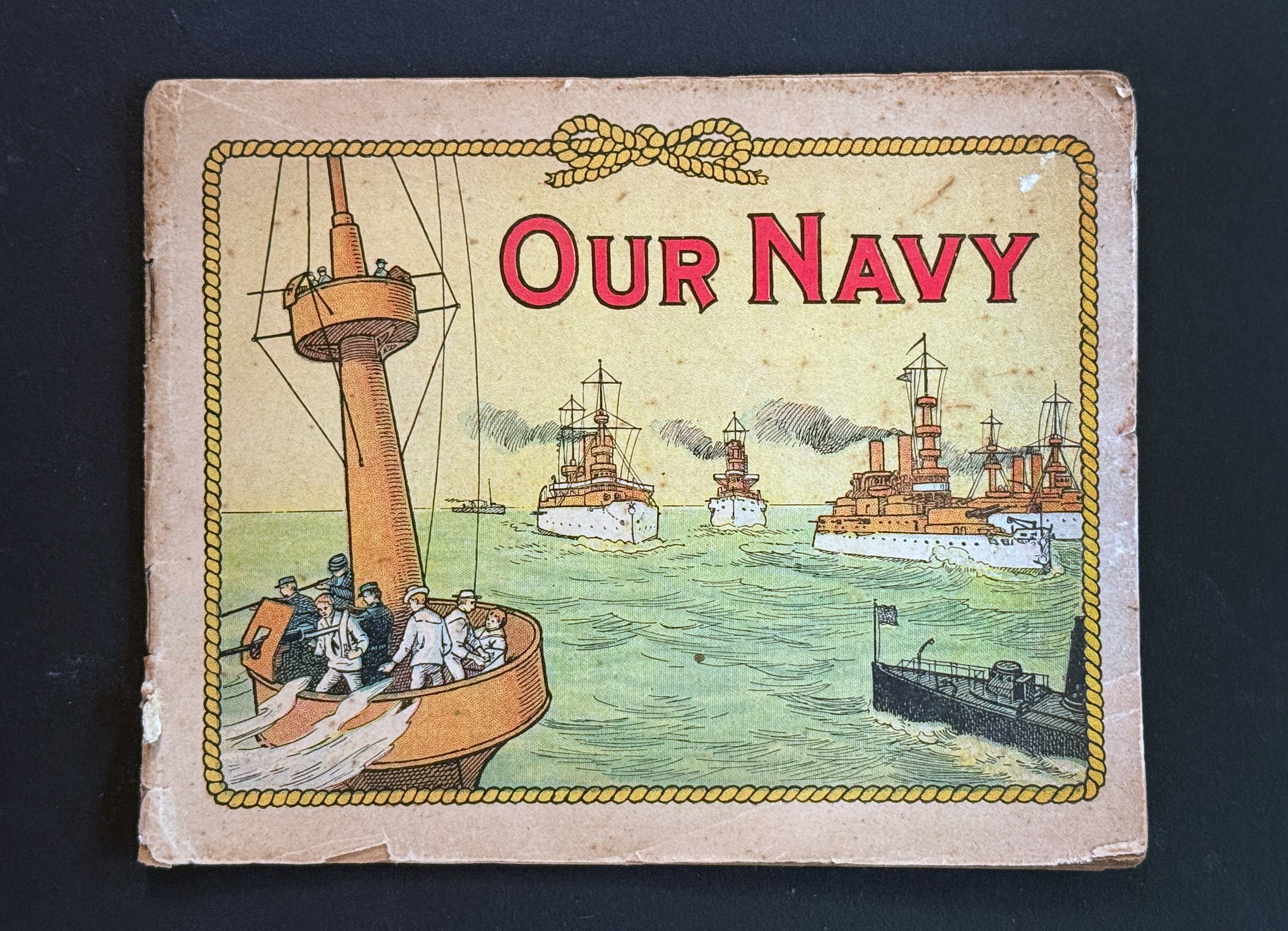
The Cure for the Modern Navy
It arrives looking like a patriot’s keepsake. The cover is all rope-knot borders and steaming battleships, a lookout perched in his fighting-top while the fleet churns past in line astern. Open it expecting the pride of the new American steel navy — the Kearsarge, the Kentucky, the great twenty-thousand-ton dreadnoughts then rising in the yards — and you will find exactly that. You will also find, three pages on, detailed instructions for curing a morphine habit.
This is the small, marvelous deception of the patent-medicine premium. The Dr. Miles Medical Company of Elkhart, Indiana did not publish this booklet to celebrate the Navy. They published it so that a man waiting at the druggist’s counter — in this case the counter of H.A. Blackmer, on Purchase Street in New Bedford — would take it home, admire the warships, and absorb, between the halftones, the gospel of Nervine. “The Nerves are the Life of the Body,” one spread insists beside an anatomical figure wired like a telephone exchange. Another assures the sufferer of “locomotor ataxia” that relief is at hand. A third, the strangest and best of all, lays out a calm domestic protocol for breaking free of the drug habit — hot baths, a blanket, a quart bottle of diminishing morphine — underwritten, naturally, by Dr. Miles’ own remedies.
It is a document of its precise moment: the years just before the Pure Food and Drug Act would force the quack empires to account for what was in the bottle. The Navy it describes is equally of that moment — the Great White Fleet steaming toward its circumnavigation, the country newly convinced of its place among the sea powers. Two American confidences, naval and pharmaceutical, bound together in a single throwaway pamphlet that somehow was not thrown away.
The back wrapper keeps the human trace: a portrait of one Ward L. Goding of Durmid, Virginia, “severe heart trouble relieved with Dr. Miles’ Heart Cure,” and below him the compliments of the New Bedford druggist who handed the booklet across his counter more than a century ago.
Condition & honest notes: This is a survivor, and it wears its survival plainly. There is chipping and short tearing to the edges, a torn corner across two of the Navy leaves, missing paper at the lower edge of some pages, and the toning and soiling that a hundred years of newsprint earns honestly. The color wrappers remain bright and whole, and every page of text reads clean. We offer it as what it is — a genuine, well-traveled artifact of American advertising, not a pristine specimen, and priced as such.
Format: Softcover advertising booklet, chromolithographed color wrappers, approx. 32 pages. Dr. Miles Medical Co., c. 1907–1909. Distributed by H.A. Blackmer, New Bedford, Mass.
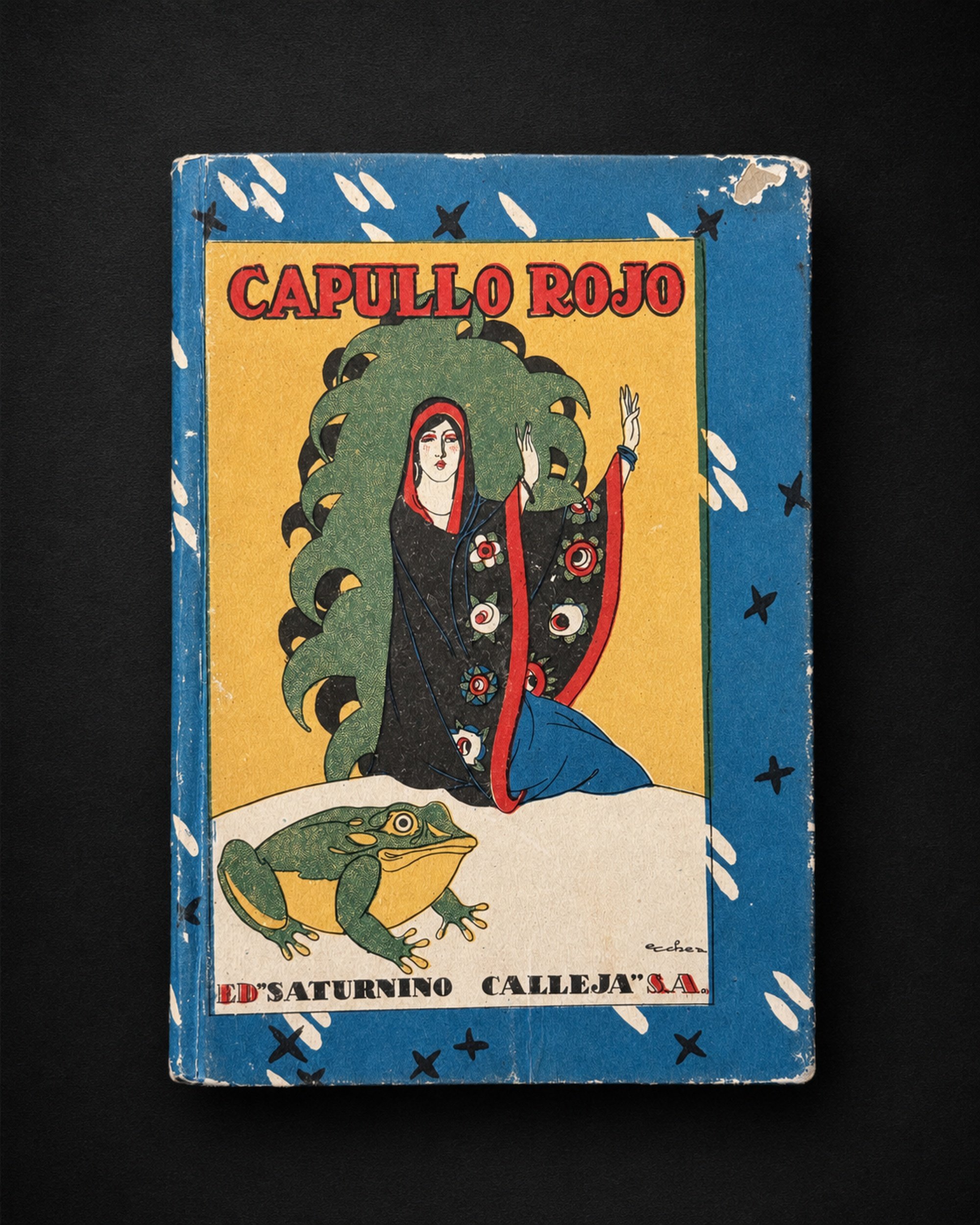
A small book carrying a big piece of Spanish publishing history. Capullo Rojo comes from Editorial Saturnino Calleja’s “Cuentos de Calleja” series — the house sometimes called Spain’s own children’s-book empire, which put fairy tales and folklore into the hands of a generation of Spanish schoolchildren in the early 20th century. This volume, No. XXXII in the Biblioteca Escolar Recreativa line, gathers four illustrated stories under J. Zamora’s artwork.
The front cover does the talking: a veiled figure fanned by a sweep of stylized green hair against gold, rendered with the flat graphic confidence of full Art Deco. It’s the kind of cover that earns a spot on a shelf even for readers who don’t speak a word of Spanish.
Well-loved, with honest wear — a chipped spine, a bumped corner — but the artwork and stories inside remain intact and legible.
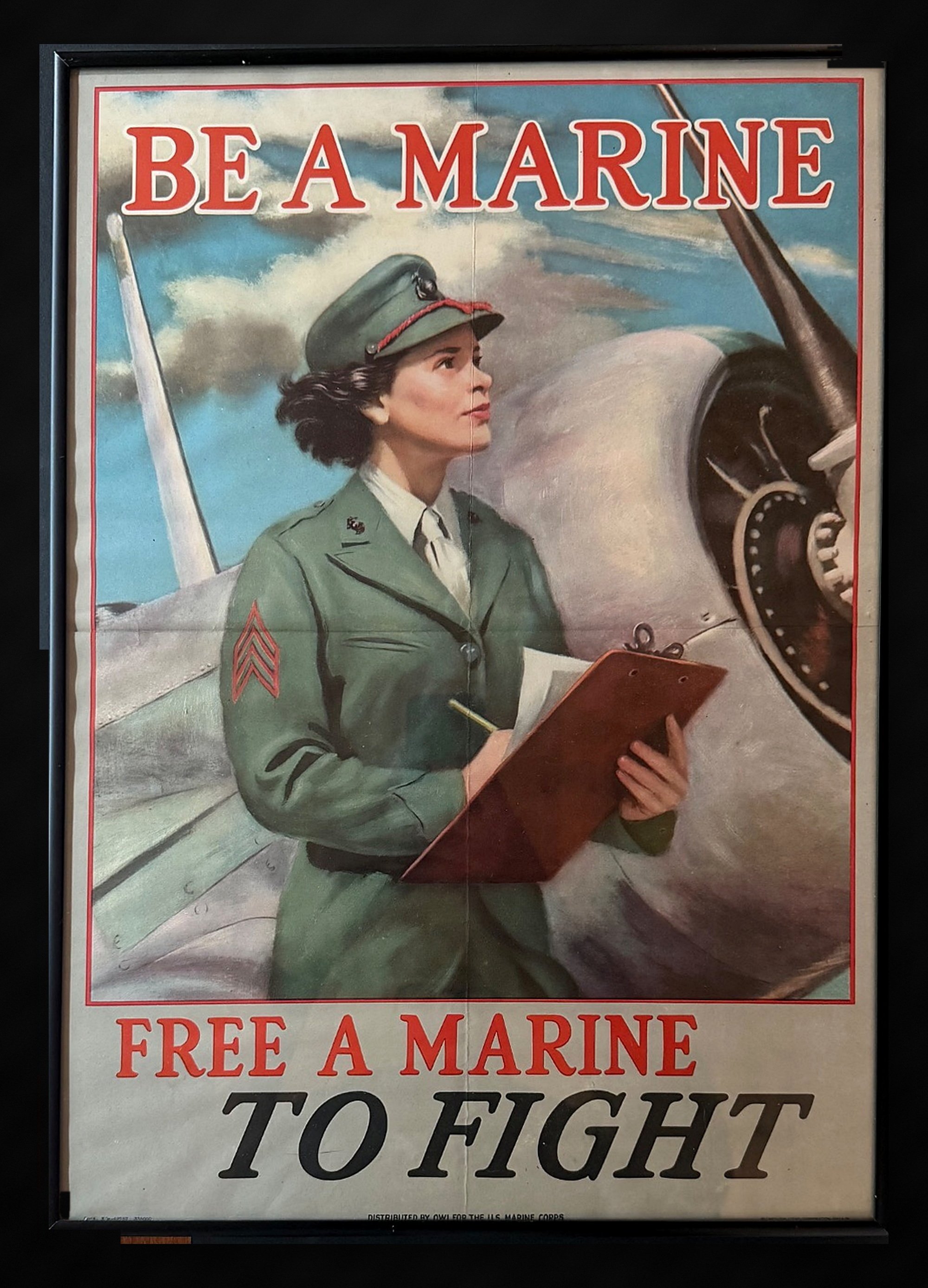
Original World War II U.S. Marine Corps Women’s Reserve recruiting poster, “Be a Marine, Free a Marine to Fight,” 1943. Distributed by the Office of War Information for the U.S. Marine Corps (distribution line printed in the lower margin). Printed by McCandlish Litho Corporation, Philadelphia. Small format, 14 × 20 inches.
A uniformed Women’s Reserve Marine, clipboard in hand, inspects an aircraft, modeled by Veronica Byrnes Bradley (1923-2018), a real WR who repaired planes in California before discovering her own likeness had become the campaign. “Free a Marine to Fight” was among the most effective recruiting slogans of the war, out-pulling the WAC, WAVES, and SPARS campaigns; nearly 19,000 women answered it.
Color lithograph on paper. Vertical and horizontal fold lines present as issued, consistent with wartime distribution, normal and expected for this format. [CONDITION - PLEASE CONFIRM IN HAND: even, light age-toning; strong color retention; no tears or losses observed in photos; frame shows light shelf wear.] Housed in a black metal frame with wire hanger (see reverse photos). Believed original wartime printing based on the OWI/USMC distribution line.
About the Memory Shop
I've spent more than fifty years collecting artifacts of the stories, characters, and worlds that inspire me — comics, science fiction, film, television, genre fiction, games, toys, and more. What began as wonder became fascination, which then became a lifelong pursuit.
The Memory Shop of Concord is the result of that lifelong engagement — a place where every object is chosen for what it means, not just what it's worth.
These are things that once sparked imagination. And still can.